
Who Makes Money in AI (Ebook): A Field Guide for Founders, Operators, and Investors
$12.99
Who Makes Money in AI
A Field Guide for Founders, Operators, and Investors
Ebook · PDF + EPUB
$12.99
From the bookA system of record keeps 52¢ of each revenue dollar, 49¢ after the capital charge.
- Instant download
- EPUB and PDF in one ZIP
- Final sale, no refunds
If a file or code doesn’t work, we send a working one within two business days.
Look inside: full contentsThe author is interviewed on NYSE TV · Nasdaq · CNBC TV18 · Forbes Councils
You finish with
- Your company’s cash position in the AI stack: gross margin, capital per dollar of revenue, cash timing and rebuild speed
- The move out of a thin wrapper into a system of record that compounds
- The questions investors ask before they fund an AI company, from Part Seven
EPUB and PDF in one ZIP · 343 pages in print
The Who Makes Money in AI ebook is the 343-page book by Nitin Kumar, in EPUB and PDF, a field guide to AI cash flow and defensibility, written for founders, operators and investors.
Use it when your product sits on someone else’s model and your margin moves with their price list. The book shows you what to build that lasts, how to pivot out of a thin wrapper and where to put capital. Two free articles apply it: where to invest in AI and how to make money in AI.
Download
Your download link arrives by email after payment. Download the ZIP and extract it before opening the ebook files. This is a digital edition, and no physical book ships.
Prefer print? Choose the paperback edition.
Once you know your position, Pricing AI Products shows you how to charge for what you build there. Browse all ebooks.

More product images


The question
Where to invest in AI?
Who Makes Money in AI by Nitin Kumar scores 12 positions in the AI stack on gross margin, capital per dollar of revenue, cash timing and rebuild speed. Chipmakers added $9 trillion in market value since the end of 2022, against $246 billion for software companies that own systems of record. The book’s investor playbook shows where that gap is mispriced.
The question
How to make money in AI?
Own the scarce input or the system of record a customer cannot leave. In Who Makes Money in AI, Nitin Kumar shows a system of record keeping 52¢ of each revenue dollar, 49¢ after the capital charge, while a thin wrapper pays its model vendor on every call.
Market value added since the end of 2022
Chipmakers took most of the AI money so far
Cash in AI flows to whoever owns the scarce input or the system of record a customer cannot leave. A thin wrapper pays its model vendor on every call, and its margin falls each time that vendor ships the same feature. The book shows you how to move your company to a position that keeps its cash.
- $9Tadded by the companies that design and make chips
- $246Badded by the software companies that own systems of record
- 52¢of a revenue dollar kept by a system of record, 49¢ after the capital charge
Inside the book
The profit gap between systems of record and wrappers
A real system of record beats a wrapper by more than fifty times on the book’s compounding test, yet investors price them less than two times apart. The book shows you what that gap means when you invest or raise.
- 12Positions in the AI stack
- 4Numbers each position sets
- 3Mispricings in the market today
- 343Pages in seven parts
Watch · 1:10
Scalable revenue and predictable cash flow
Nitin Kumar on revenue that scales and cash flow you can predict, the test the book applies to every position in the AI stack.
More interviews on the Press page
The author
Nitin Kumar
Global multi-scale CEO · Startups to multi-billion-dollar P&L · 2x exits
In 28 years in technology, Nitin Kumar has led businesses at every scale up to a $2B+ P&L and taken two companies through pivots to exit as CEO. He has worked on about two dozen pivots as a CEO, operator, consultant and advisor, and his books show how a product gets built, priced, sold and repositioned when its market moves. CEO Today Magazine featured him as the Master of the Business Pivot, and he is one of Silicon Valley’s Magnificent Four.
He has made more than 10 angel investments and sits on startup boards, so the investor’s playbook in Part Seven comes from both sides of the table.
Interviews and featuresCEO TodayNYSE TVNasdaqCNBC TV18Forbes Councils
About Nitin Kumar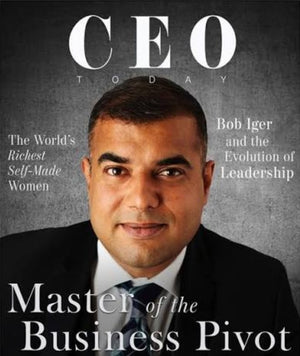
Look inside

Contents
See the full contentsHide the contents
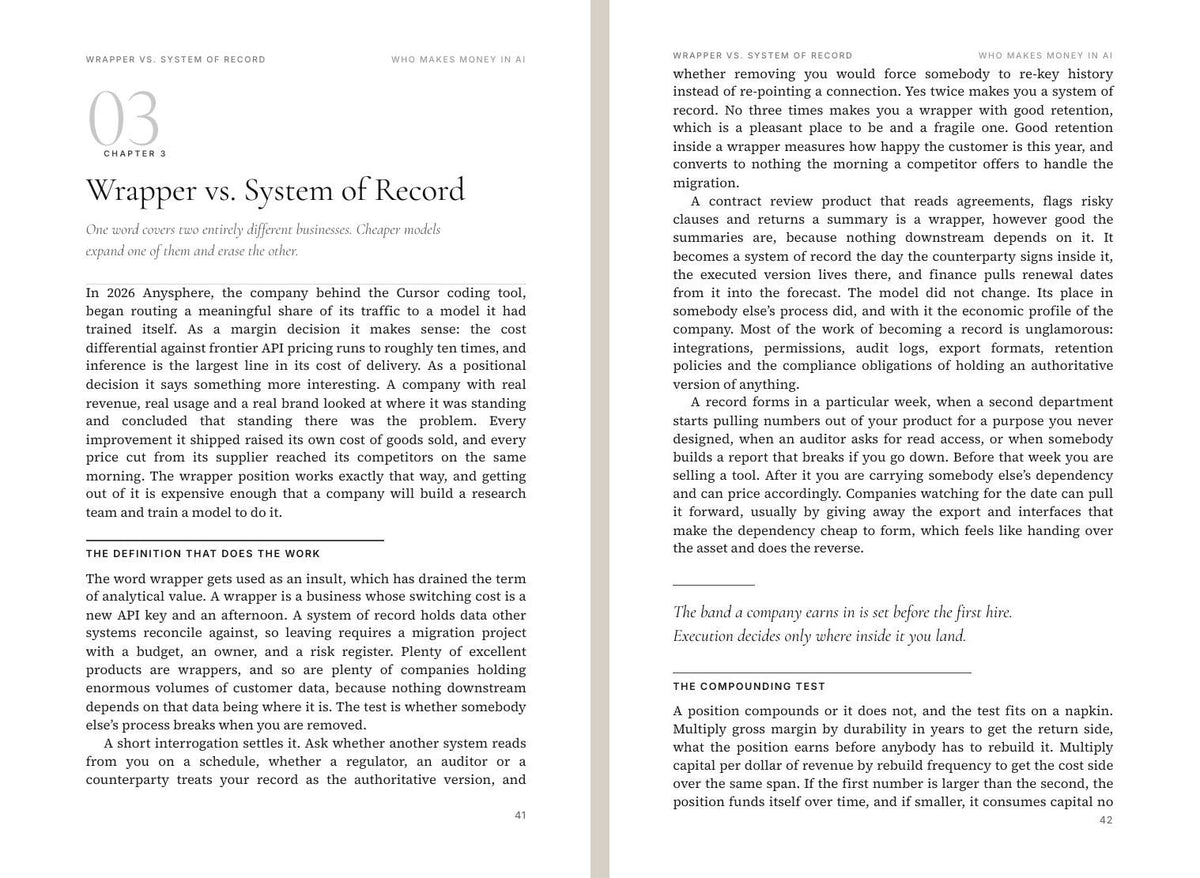
- Part One, The landscape. The Money Moved Upstream · Twelve Positions in the Stack · Wrapper vs. System of Record · Artifact Liquidity and Coordination Load
- Part Two, Revenue. The Form Decides the Cash · The Risk in the Price · Revenue Stopped Meaning One Thing · The First Dollar Costs an Engineer · Distribution Has to Be Bought
- Part Three, Cash. Revenue Is Not Cash · The Margin Trap · Cost Engineering · Audited and Asserted · The Financing Chain · Does the Machine Pay for Itself? · If Inference Reprices
- Part Four, Sustaining. Your Supplier Enters Your Market · Depth of State Holds the Customer · Forty Percent Gross Retention · The Attribution Gap · The Attach Line · The Data Position
- Part Five, Capital. Who Needs Capital · Sizing the Round · Timing the Round · The Second Owner · The Payout
- Part Six, The operator’s playbook. The Record Forms in the First Quarter · The Seven-Month Gap · Anatomy of a Company
- Part Seven, The investor’s playbook. The Entry Multiple No Exit Pays · Underwriting a Position · Portfolio Construction and Risk
- Close, The argument on trial. The Mispricing · The Stress Test
From the book
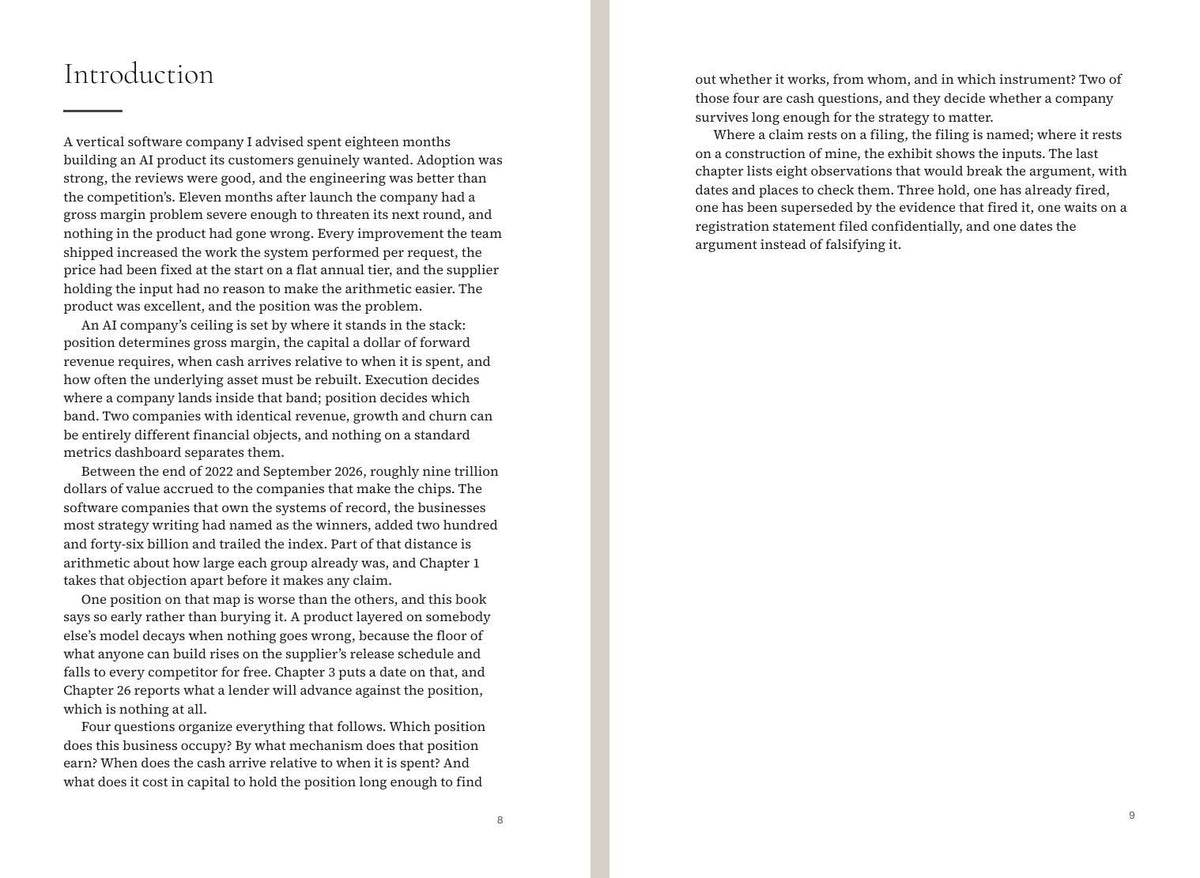
A vertical software company I advised spent eighteen months building an AI product its customers genuinely wanted. Adoption was strong, the reviews were good, and the engineering was better than the competition’s. Eleven months after launch the company had a gross margin problem severe enough to threaten its next round, and nothing in the product had gone wrong. The product was excellent, and the position was the problem.
From the introduction, Who Makes Money in AI
Questions
Ask your own through the contact page.
Who makes money in AI?
The chipmakers have so far, Nitin Kumar shows in Who Makes Money in AI. Between the end of 2022 and September 2026, the companies that design and make chips added roughly $9 trillion of market capitalization, while the software companies that own systems of record added about $246 billion. The book maps twelve positions in the AI stack and how each one earns.
What is the difference between an AI wrapper and a system of record?
In Who Makes Money in AI by Nitin Kumar, a wrapper is a business whose switching cost is a new API key and an afternoon. A system of record holds data other systems reconcile against, so leaving it takes a migration project with a budget and an owner. The book’s test is whether somebody else’s process breaks when you are removed.
How much of a software dollar does an AI vendor keep?
In the worked example in Nitin Kumar’s Who Makes Money in AI, a vendor billed $100 a month keeps $52 as gross profit. Of the $48 cost of delivery, $23 goes to inference and $25 to hosting and support, and the model owner keeps about $14 of the $23 it receives. The $52 is a modeled figure, and chapter 11 sets out its basis.
More books by Nitin Kumar
-
 Pricing AI Products
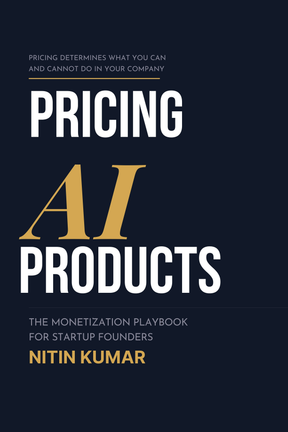
How to charge for AI by seat, credit, usage or result, and when each one works.
$12.99 · EPUB + PDF
-
 The AI Business Bundle
Pricing AI Products and Who Makes Money in AI as two paperbacks.
$50.00 · saves $19.98
-
 The Startup Pivot Playbook
The order of moves from 75 scored pivots, with the 30-worksheet PDF Toolkit in both editions.
$29.99

