
The Startup Pivot Playbook (Audiobook): How to Pivot a Startup
$9.99
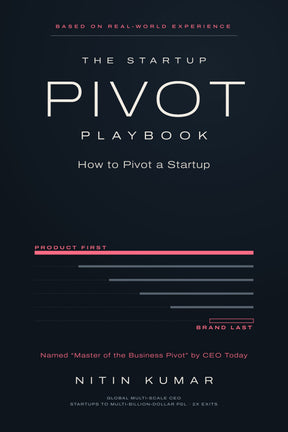
The Startup Pivot Playbook
How to Pivot a Startup
Audiobook · about 7 hours
$9.99
From the bookIn 75 scored pivots, 21 of the 33 companies that moved the product first succeeded.
OrThe ebook at $12.99 includes this audiobook, plus the EPUB, the PDF, the PDF Toolkit, the Interactive Toolkit (full, with the book) and a first month of coaching.
- Plays in your browser
- Link and code by email
- Final sale, no refunds
If a file or code doesn’t work, we send a working one within two business days.
Look inside: full contentsThe author is interviewed on NYSE TV · Nasdaq · CNBC TV18 · Forbes Councils
Audiobook, about 7 hours, with read-along text

More product images


Inside the book and PDF Toolkit
The PDF Toolkit
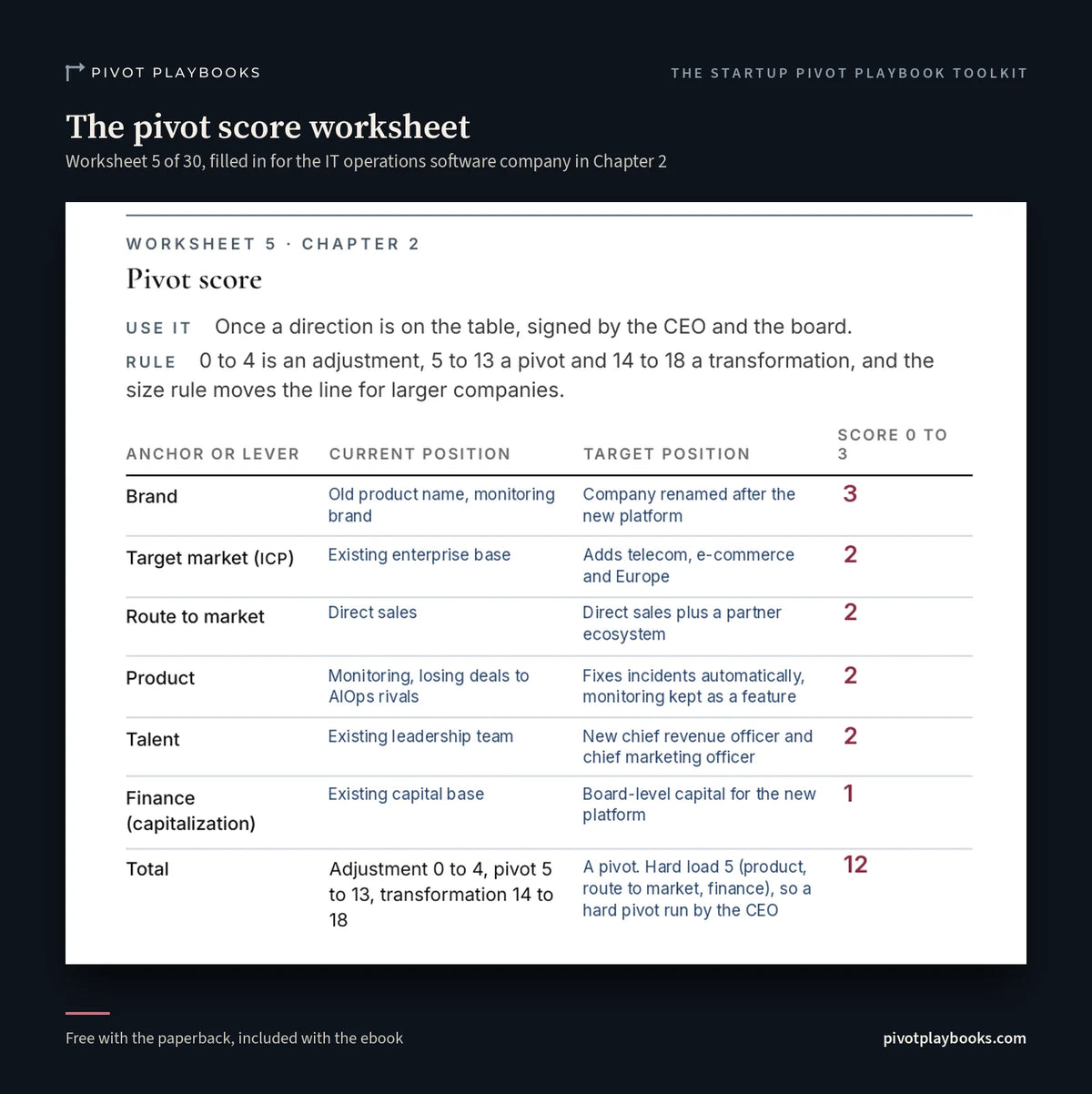
Each chapter ends with a worksheet you fill in with your own numbers. Worksheet 5 scores the IT operations software company from Chapter 2 at 12 points, a hard pivot that the CEO has to lead.
- 30Worksheets and calculators
- 75Scored pivot cases
- 63Tables and figures
- 24Chapter checklists
From 75 scored pivots
Move the product first and the brand last
The 75-case database compares the order of product, market and brand changes. The results below describe this scored sample.
- 64%of pivots that moved the product first succeeded, 21 of 33
- 17%of halfway moves, such as a new tier or a feature, succeeded, 2 of 12
- 0 of 8companies succeeded when they changed the brand before the product was ready
The cases were selected from documented pivots, rather than a random sample. They include large companies as well as startups. Treat these results as evidence about the order of moves, not a forecast of your company’s odds.
Inspect the scored cases and methodPreface: The pivots behind the method
The pivots that fail share one pattern. The product moves, and the brand, the buyer, the channel, the price and the people stay where they were.
The renewal that changed how I read a business came from a large bank. At the IT operations software company I ran as CEO, the bank’s operations head kept our monitoring. He sent his expansion budget to a vendor that promised to cut the number of incidents his team touched. Our churn stayed at zero while that money went to a rival. From that renewal on I read lost expansions as the pipeline report and renewals as history.
Most pivots fail in the order of their moves. A company changes its product and leaves the brand, the channel, the price and the people pointed at the old buyer. Another changes the promise before the product can keep it. A buyer in diligence spots the half-finished pivot in the first week, because the product deck describes a new platform while the pipeline report still lists the old buyer, the price book still prices the old category and the sales team is paid to sell the thing the company says it no longer is. I watched acquirers discount companies for exactly this gap. The discount equaled the cost of bringing the rest of the company into line with the new product.
Keep reading the preface
I have seen the gap from both sides of the table. My first two decades went to Hewlett-Packard, Deloitte, PwC and FTI Consulting. Over my career I have worked on hundreds of diligences spanning commercial, operational, pricing and pivot work, including deals for private equity and venture capital clients. I have worked on about two dozen pivots as a CEO, operator, consultant and advisor, each taking three to six months to execute, and on dozens of transformations as an advisor, so repetition turned pivoting into a method with scores, gates and an order of moves. The three most recent pivots I led supply this book’s first-hand evidence. A marketing technology company I advised joins them, after it narrowed five products sold to five buyer types down to one sales-led motion.
The first-hand cases
The IT operations company sold monitoring under an old brand. Competitors with AIOps were winning new deals while the installed base kept renewing. Our best customers used the product to stop incidents before a person had to act. So I ran a brand and positioning pivot to automated remediation, moved the product first and renamed the company last. We hived the services business into a separate entity and later sold it. A little more than a quarter after the decision, 35% of new pipeline named the new outcome in the first call. Chapters 8, 14, 16 and 17 each tell one part of that pivot.
At the legal technology company I took over as CEO from its founder. The company was a services business with a software product inside it, billing per litigation matter with a project team attached to every dollar. We stopped selling to law firms one matter at a time and rebuilt the product for the legal operations teams who run a legal department as a business. Then we moved to value-based pricing and renamed last, once the first customers had bought on the new promise. A larger legal technology vendor bought the company and priced it as a product business, and Chapter 9 tells the full story.
The M&A software company sold cloud software to corporate development and integration teams. Then an abrupt personal situation took its founder and chief executive out of the business, and much of the team left soon after. I stepped in from the board and ran the pivot hands-on. With deal volume down and large language models absorbing the workflow tasks older SaaS charged seats for, we left the category. We turned an internal content engine, built to market the company itself, into an agentic go-to-market platform for founders and lean growth teams. I remain on its board, a new team runs the company, and Chapter 20 tells the full story.
Alongside those three, I have worked on SaaS pivots as an operator, a pricing advisor and a consultant to venture and private equity funds. Some moved companies from perpetual licenses to subscriptions, including a marketing technology client I consulted to. The client’s board signed a one-page drawing of the revenue dip before the first quarter of the change. Others demoted products to features of a larger platform or promoted a feature customers used more than the product around it. Eric Ries’s catalog calls these the zoom-out and zoom-in pivots.
The pattern under the pivots
Each company kept a core asset and replaced most of what was built on top of it. In every case the pivot forced changes nobody had planned in the first board deck. A new buyer meant a new sales leader, a new brand meant a new price conversation, and a new channel meant partners who needed margin, training and a product they could deploy without us in the room. I came to see the anchors of a business as coupled, so that moving one makes the others follow by design or follow later at higher cost.
In April 2020 CEO Today published the pivot framework I had built from those years and featured me as the Master of the Business Pivot. The framework names when to pivot, the four anchor points to design around, and the practices that separate pivots that work from those that stall. Chapter 1 sets it out in full, and every chapter after it applies one of its parts.
The order of moves
To test the order of moves I scored 75 documented pivots, the earliest Wrigley in 1892 and the latest the AI pivots of 2024. Companies that moved the product first succeeded far more often than companies that moved it only halfway, and none of the companies that changed the brand before the product could back it succeeded. The product moves first and all the way, the anchors coupled to it follow in the order of their pull, and the promise moves last, once the product and the first customers can keep it. The pivot score in Chapter 2 measures how far that sequence will take the company and whether the move is a pivot or a transformation.
I wrote the book for founders, and it still spends pages on Intel, Adobe, Netflix and Microsoft. Large companies leave filings and dated outcomes, while most startups that pivoted and failed left no record. As a result, 35 of the 75 scored pivots come from large companies and give the clearest evidence on the order of moves. Their mistakes repeat at startup scale. The gap in success rates between hard and soft pivots runs 18 points at startups and 48 points at large companies, so a large company shows a founder the same error at a price the founder never has to pay. The investors and acquirers a founder meets at the next round and at the exit also run large companies or answer to them, and a founder who reads a pivot the way they do negotiates from a stronger position.
I run pivots as a discipline with measures, rules and evidence, closer to engineering than to instinct. Instinct spots the opening, and measurement turns it into a pivot that works, with a score for the size of the change, a database of 75 cases for the odds, a sequence for the order of moves, gates with kill criteria for the money and a pre-mortem for the ways it can fail. Every chapter adds an instrument, so that two leadership teams facing the same facts reach the same decision.
Chapter 1: Most pivots fail in the order of their moves
A pivot changes what a company solves and moves every anchor of the business with it. The pivots that fail usually moved the promise before the product could keep it, or moved one anchor while the rest kept running the old plan.
One meeting repeats in almost every transformation I have advised. The CEO presents the new direction, and twenty minutes later the head of sales forecasts the quarter from the old pipeline, against the old buyer, at the old price, with the sales team paid on the old product. I now ask one question in that meeting: what share of next quarter’s forecast comes from the new direction? When the answer is close to zero, the pivot exists only in the deck.
In that meeting the strategy has moved and the anchors coupled to it have stayed put. The buyer, the channel, the price and the people still run the old plan, and each quarter they do costs the new direction a quarter of runway. The companies that pivot well move in a set order, as Tiny Speck did when it kept its team and investors and shipped the product before the Slack name, a story Chapter 6 tells in full.
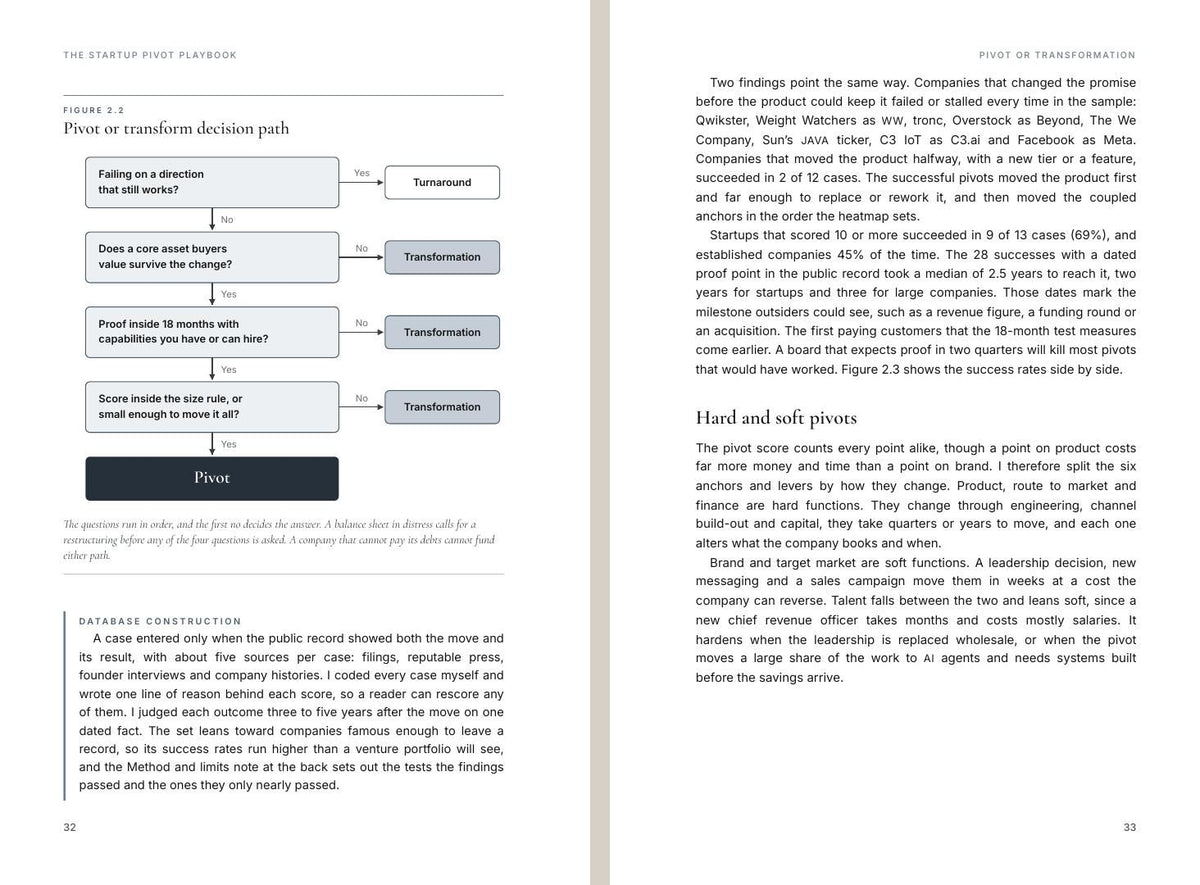
Startup Genome studied about 3,200 high-growth technology startups and found that companies that pivoted once or twice raised 2.5 times more money than companies that pivoted more than twice or never, and grew users 3.6 times faster. My database of 75 scored pivots adds the order. Product-first pivots succeeded 64% of the time and halfway moves 17%. None of the eight companies that moved the brand ahead of the product succeeded.
The full book runs 272 pages, with the pivot framework, the pivot score and the 75-case database.

The author
Nitin Kumar
Nitin Kumar led an IT operations software company and a legal technology company through pivots to exit as CEO. The book draws on those cases and his work on about two dozen pivots as a CEO, operator, consultant and advisor.
Look inside
Contents
See the full contentsHide the contents
- Part I, Pivot fundamentals. Most pivots fail in the order of their moves · Pivot or transformation · Signals and timing · Product first, promise last · Pivot execution and KPIs · Failure and recovery
- Part II, Pivot types and their consequences. Product-market fit pivots · Product pivots · Service to product pivots · Target market and ICP pivots · Route to market pivots · Positioning pivots · Pricing pivots · Business model pivots · Capital pivots · Talent and organization pivots · Brand pivots · M&A as a pivot tool
- Part III, Pivot to AI. Add, pivot or hold · SaaS to AI · Pivot out of an AI wrapper · AI workforce · AI-enabled services · Finding alpha from a pivot
- Reference. Method and limits · Glossary · Sources · Index · The pattern in 75 pivots
Questions
Ask your own through the contact page.
Who narrates the audiobook?
The Startup Pivot Playbook audiobook is narrated by Kokoro Heart, an AI voice, reading Nitin Kumar’s full text. Read-along text follows the voice as it plays.
How do I listen?
The Startup Pivot Playbook audiobook streams in your browser, so it needs an internet connection. There is no download or offline mode. The workspace link arrives in your order email, and your personal code in a separate email labeled License Key.
Is the audiobook included with the book?
Yes. Both editions of Nitin Kumar’s The Startup Pivot Playbook, the $29.99 paperback and the $12.99 ebook, include the audiobook, the Interactive Toolkit (full, with the book) and the first month of coaching.
How long is the audiobook?
The Startup Pivot Playbook audiobook runs about 7 hours and covers every chapter of the book.
Does the audiobook include the toolkit?
The $9.99 audiobook of The Startup Pivot Playbook is the narration and read-along text only. The ebook, at $12.99, adds the EPUB and PDF editions, the PDF Toolkit, the Interactive Toolkit (full, with the book) and a month of coaching.
More books by Nitin Kumar
-
 The Startup Pivot Playbook
The order of moves from 75 scored pivots, with the 30-worksheet PDF Toolkit in both editions.
$29.99
-
 The Startup Diagnostics Bundle
Both pocket diagnostics, on go-to-market and on product, as two paperbacks.
$32.99 · saves $6.99
-
 Pricing AI Products
How to charge for AI by seat, credit, usage or result, and when each one works.
$29.99

