
The AI Pivot for Fashion Brands: How to Use AI in a Fashion Business
The AI Pivot for Fashion Brands: How to Use AI in a Fashion Business
- Printed in 2 to 5 business days
- US shipping from $7.42
The author is interviewed on NYSE TV · Nasdaq · CNBC TV18 · Forbes Councils
You finish with
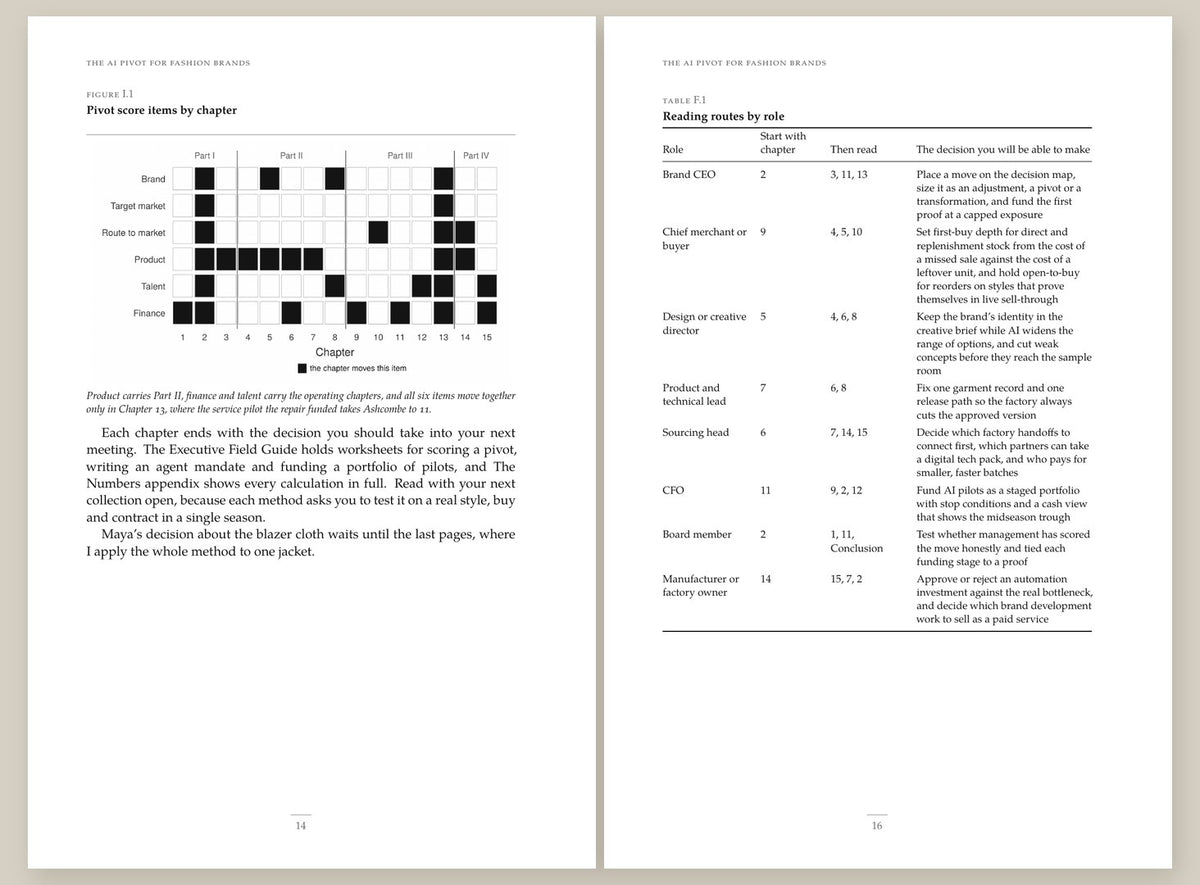
- Each AI project scored on the six-item pivot score, 0 to 18
- The Decision for Monday at the end of every chapter, one move for that week
- The Numbers appendix, so your finance team can rerun every figure on its own data
Paperback, 6 x 9 in · 233 pages · ISBN 9798992302479 · Ships from the US, UK or Canada
The AI Pivot for Fashion Brands is a guide to using AI in a fashion business, written for brand leaders and manufacturers.
Use it when you need to pick which AI project to fund first, and your team is ready to move past marketing pilots into design, sourcing and production.
Its pivot score comes from The Startup Pivot Playbook.


From a survey of 250 fashion professionals
Start with the decision AI will change
Every AI project in fashion ends at something someone signs: a fabric booking, a purchase order or a reorder. The book shows you which of those decisions to change first and what each change is worth to the brand.
- 3.8out of 5, the impact fashion professionals give marketing and content AI
- 2.1out of 5 for production and technical AI, a 1.7-point difference the book calls the production gap
- 15public fashion pivots scored, including Nike, Burberry and Shein
Inside the book
The Decision for Monday
Each chapter ends with The Decision for Monday, one move you can make that week. The Numbers appendix shows every calculation, so your finance team can rerun it on its own data.
- 233Pages in four parts
- 250Fashion professionals in The State of AI Fashion 2026 survey
- 2Chapters for manufacturers
- 6Items in the pivot score

The author
Nitin Kumar
Global multi-scale CEO · Startups to multi-billion-dollar P&L · 2x exits
He is co-founder and CEO of The F* Word, AI-native workflow software that takes apparel brands and manufacturers from trend to production.
About Nitin Kumar
About the book
The AI Pivot for Fashion Brands by Nitin Kumar, co-founder and CEO of The F* Word, is a 233-page playbook for the fashion leaders who decide what a brand develops, buys and promises. It follows two composite companies through one AI pivot each: Ashcombe, a $60 million tailoring brand, and Kaveri Garments, its factory near Bengaluru. It also scores 15 public fashion pivots, including Nike, Burberry, Coach, Shein, Zalando and The RealReal, on one six-item pivot score. Every chapter ends with The Decision for Monday, and The Numbers appendix works each figure in full so a finance team can rerun it on its own data.

Look inside
Contents
See the full contentsHide the contents
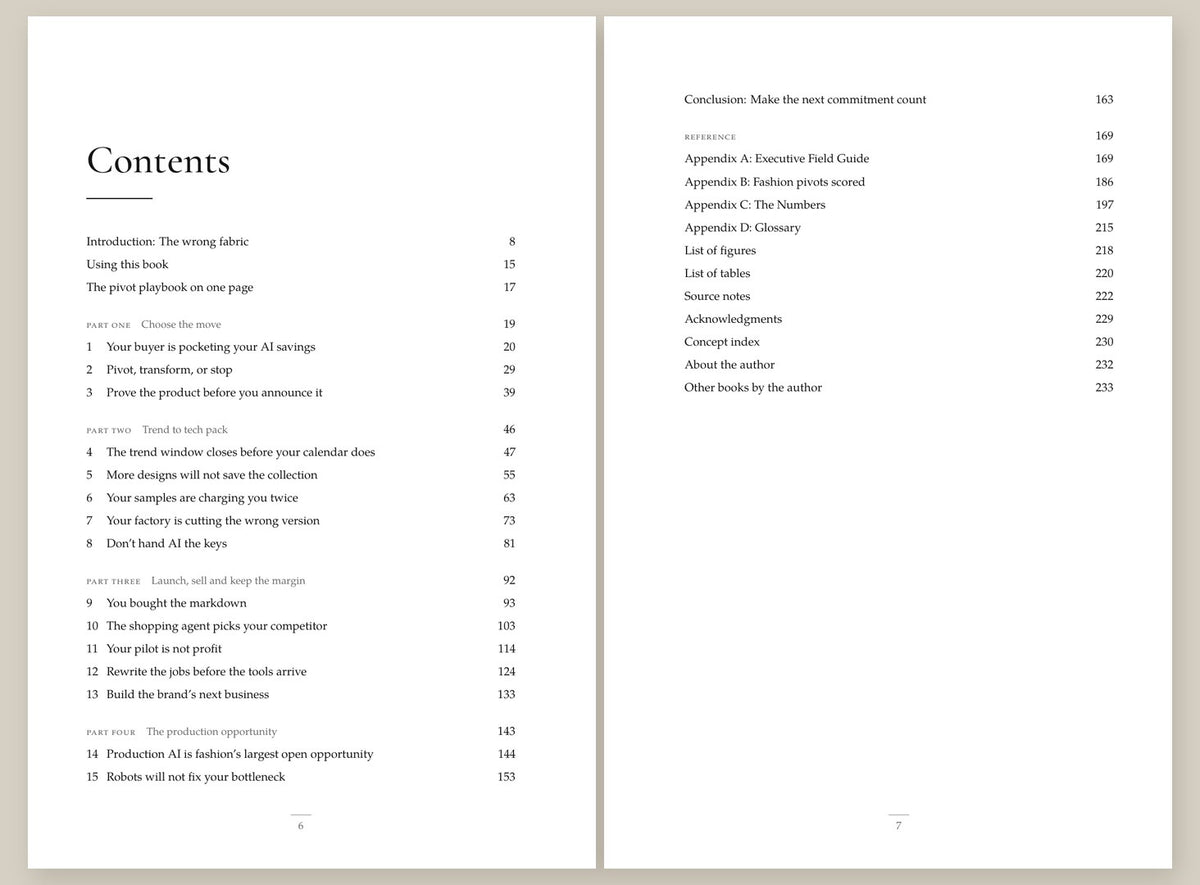
- Part One, Choose the move. Your buyer is pocketing your AI savings · Pivot, transform, or stop · Prove the product before you announce it
- Part Two, Trend to tech pack. The trend window closes before your calendar does · More designs will not save the collection · Your samples are charging you twice · Your factory is cutting the wrong version · Don’t hand AI the keys
- Part Three, Launch, sell and keep the margin. You bought the markdown · The shopping agent picks your competitor · Your pilot is not profit · Rewrite the jobs before the tools arrive · Build the brand’s next business
- Part Four, The production opportunity. Production AI is fashion’s largest open opportunity · Robots will not fix your bottleneck
- Reference. Executive Field Guide · Fashion pivots scored · The Numbers · Glossary · Source notes · Concept index
From the book
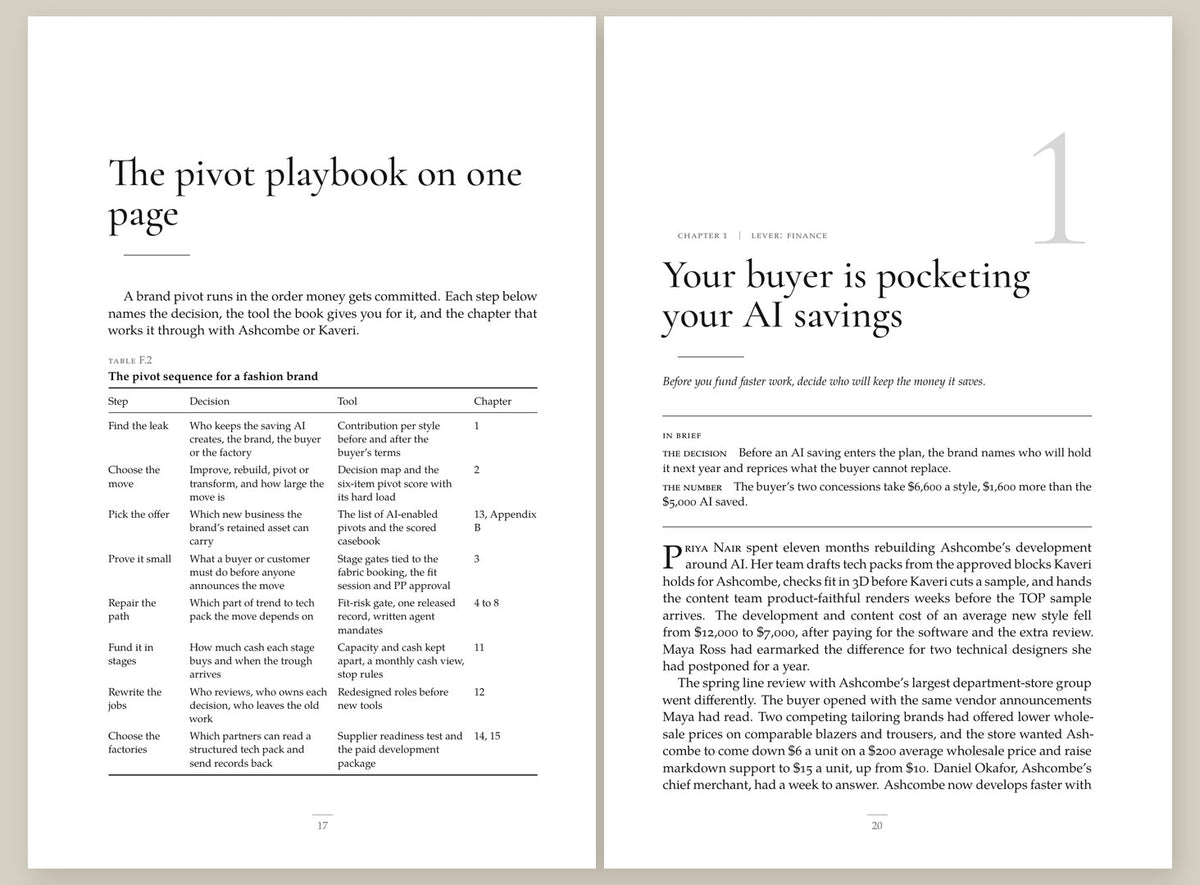
The cloth for Ashcombe’s autumn travel blazer was due at Kaveri Garments in the first week of June. On a Tuesday in May, the Italian mill wrote to say the navy wool twill would ship six weeks late. Kaveri’s cutting slot fell eleven days out. Ashcombe’s department-store buyers expected the blazer on the floor for the autumn set, and its content team had already shot the campaign in the approved cloth.
From the introduction, The AI Pivot for Fashion Brands
Questions
Ask your own through the contact page.
How should a fashion brand decide where to use AI?
Start with the decision the AI project changes. The AI Pivot for Fashion Brands by Nitin Kumar scores each AI move on four anchors (brand, target market, route to market and product) and two levers (talent and finance) at 0 to 3 each. A total of 0 to 4 is an adjustment, 5 to 13 a pivot and 14 to 18 a transformation.
What is the production gap in fashion AI?
In The State of AI Fashion 2026, a survey of 250 fashion professionals in more than 90 countries by The F* Word, respondents rated the impact of marketing and content AI at 3.8 out of 5 and production and technical AI at 2.1. The report calls the 1.7-point difference the production gap, and the book treats production as fashion’s largest open AI opportunity.
What is the difference between a pivot and a transformation for a fashion brand?
A pivot keeps an asset customers still value and changes what the brand sells, to whom or how it gets paid, as Coach did in fiscal 2016 when it cut wholesale doors and markdown allowances. A transformation rebuilds most of the business at once, as Burberry began to do with Burberry Forward in November 2024.
Does the book cover manufacturers?
Yes. Part Four follows Kaveri Garments and covers where production AI pays a factory and when sewing automation pays back, including how a factory can price its development work as a separate package.
More books by Nitin Kumar
-
 The Startup Pivot Playbook
The order of moves from 75 scored pivots, with the 30-worksheet toolkit free in the paperback.
$29.99
-
 Pricing AI Products
How to charge for AI by seat, credit, usage or result, and when each one works.
$29.99
-
 Who Makes Money in AI
Which part of the AI stack keeps the revenue and the margin, position by position.
$39.99
