Thin AI Wrappers Lose to the Model Vendor
A wrapper’s margin falls on its model vendor’s release calendar, and the companies that survived, Lovable among them, left the position by becoming the record other systems read.
By Nitin Kumar · · 6 min read
Global multi-scale CEO · Startups to multi-billion-dollar P&L · 2x exits
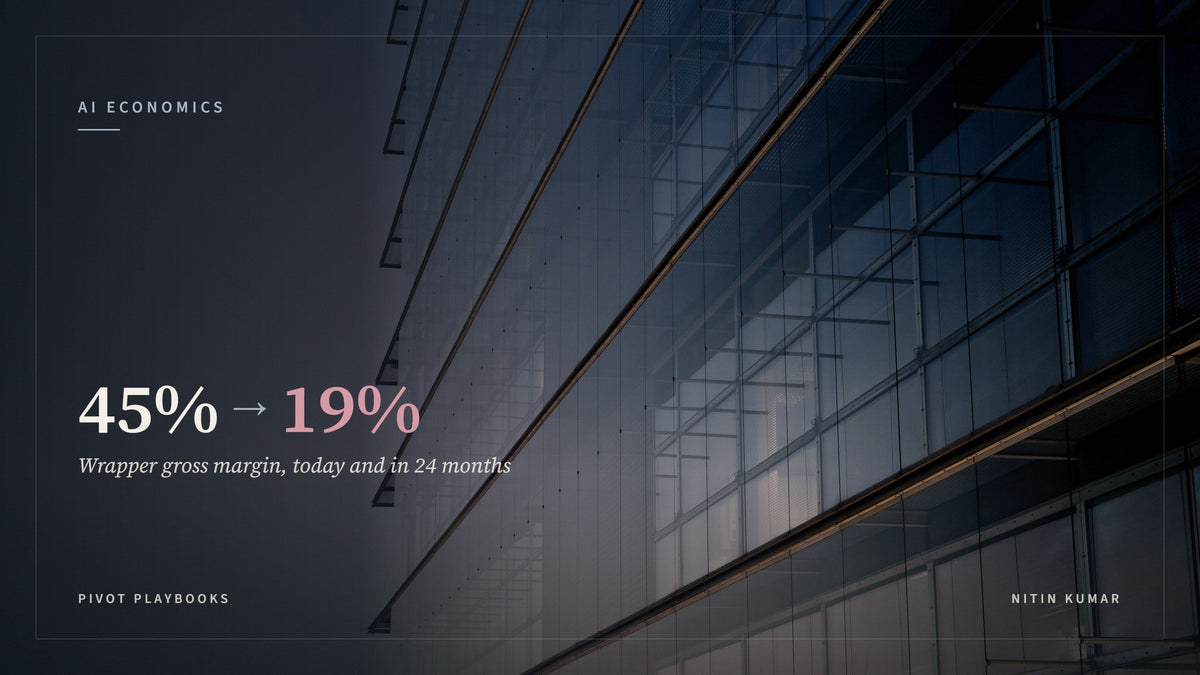
An AI wrapper is a good business until its model vendor ships the same feature, and model vendors ship every quarter. On the inputs in Who Makes Money in AI, a wrapper keeps a 45% gross margin today and drifts toward 19% two years out. Its switching cost falls over the same span from about 23 cents on the dollar of annual contract value to about 5. The wrappers that became durable companies left the position, and Lovable is the clearest public case of a wrapper moving toward the record.
Switching cost defines a wrapper
A wrapper is a business whose switching cost is a new API key and an afternoon. Plenty of excellent products fail the test, because it asks what breaks in the customer’s process when the product goes, and for most wrappers nothing downstream depends on their output. Does another system read from you on a schedule? Does an auditor, regulator or counterparty treat your record as the authoritative version? Would leaving you force somebody to re-key history instead of re-pointing a connection? A product with two or three yes answers is a system of record, and one with fewer is a wrapper whose good retention lasts until a competitor offers to run the migration for free.
The model vendor’s release calendar sets the wrapper’s margin
A wrapper needs no event to end it. Every other position in the AI stack waits for something to happen, such as a rival entering or a regulator changing a rule, while a wrapper erodes on its supplier’s ordinary schedule. Each quarterly model release lifts the floor of what anyone can build, for every competitor at once and whatever the wrapper’s team does.
The public record follows the same line. Jasper doubled recurring revenue to $80 million in 2022 on a $1.5 billion valuation, and after ChatGPT arrived as a low-cost rival it cut its 2023 ARR forecast by at least 30% and its internal valuation by 20%, The Information reported, as summarized by Maginative. When ChatGPT added PDF upload in November 2023, TechCrunch named “wrapper startups” as the most exposed, and Tome’s founders later left a presentation app with 20 million users to build a CRM.
Nobody publishes a count of dead wrappers. Carta recorded 966 shutdowns among US startups on its platform in 2024, up from 769 in 2023, per TechCrunch. Even that count misses the typical wrapper, which never raises a priced round and closes by letting a domain lapse.

Lovable left the wrapper by hosting the app
Lovable began in June 2023 as GPT Engineer. The open-source command-line tool turned a prompt into code and collected 40,000 GitHub stars in two months, Sacra reports, and it failed all three questions above because the code left with the user. The company relaunched as Lovable in November 2024. On September 29, 2025 it shipped Lovable Cloud, a built-in backend with data storage, sign-up and login, row-level security and usage-based billing, plus Lovable AI for built-in model features.
The move changed where the customer’s output lives. An app whose database, users and login sit inside Lovable takes a migration project to move, so every app built there raises its owner’s switching cost. Lovable says apps built on the platform draw close to a billion visits a month. Annualized revenue passed $600 million in September 2026, a month after a round at a $13.3 billion valuation, TechCrunch reported.
The cost side has not moved yet. Lovable still runs on models from OpenAI, Anthropic and Google, Sacra put its gross margin at 36% in May 2025 against a 65% target for the second half of 2026, and Lovable has not published churn or retention figures. The company owns the record its users depend on while it still rents the models that produce it.
Every exit from the wrapper position carries a price
Chapter 3 of the book names four routes out, and each one charges the company before the arithmetic improves.
Table 1 · Exits from the wrapper position
| Exit | What changes | Price | Who took it |
|---|---|---|---|
| Become the record | Your output becomes the version other systems read | Slow, often a new buyer, plus the compliance burden of the authoritative copy | Lovable, with a built-in backend |
| Own the cost stack | Inference you control replaces inference you rent | A research team and a rebuild every release cycle | Cursor, whose own Composer model shipped in October 2025 at about $1 billion of annualized revenue |
| Go narrow | Regulation, integrations and schema keep a general model out | A market that looks small in a pitch meeting | Harvey in legal work, which shipped its own post-trained model, Tenet, in August 2026 |
| Run it for cash | Small team, low burn, an outcome sized to the position | A ceiling on the exit, unless execution outruns the decay | Gamma, the rare exception, profitable for more than two years on $23 million raised |
Only the first exit changes the arithmetic for good. Owning the model defends the margin and buys years, but it raises no switching cost, so treat it as a way to fund the time a record takes to form.
Measure the switching cost before the next round
Take a customer paying $24,000 a year. Leaving costs 40 hours of migration at a $90 loaded rate, or $3,600, plus $2,000 for a month of paying two vendors and $800 of retraining. The $6,400 total divided by $24,000 gives a ratio of 0.27. Above 2, a customer stays for any sensible planning horizon, and near 0.2 they leave for a better demo. Halve your team’s estimate, then ask three customers and use theirs, because internal estimates forget that a rival will do the migration for free.
Then date two events: the quarter your position stops compounding on the input-price trend, and the revenue at which you could fund a model, a data asset or an origination route of your own. If the second date lands after the first, your position is an option that expires, and the honest plan is to sell before it does. Chapter 3 of Who Makes Money in AI sets out this test next to its map of twelve positions in the AI stack.
Questions
What is an AI wrapper?
An AI wrapper is a product built on another company’s model whose switching cost is a new API key and an afternoon. Who Makes Money in AI by Nitin Kumar defines it by the customer’s process: if nothing downstream breaks when the product goes, it is a wrapper, however good its output.
Are AI wrappers a good business?
Only for a limited time, because on the book’s inputs a wrapper keeps about a 45% gross margin today and about 19% two years out as base models absorb its features. Run with a small team and low burn, it can be a good small business.
Will OpenAI kill my AI startup?
A model vendor kills the products that sit one feature away from its next release, as PDF upload in ChatGPT threatened PDF chat apps in 2023. A product that holds the customer’s record, such as the executed contract, the claim file or the running app, survives the launch because leaving it takes a migration project.
How does an AI wrapper become defensible?
It takes one of four exits: become the record, own the cost stack, go narrow into a regulated vertical, or run for cash. Lovable took the first by hosting its users’ apps and data.

Nitin Kumar is a global multi-scale CEO with two exits and the author of The Startup Pivot Playbook, Who Makes Money in AI and Pricing AI Products. CEO Today featured him as the Master of the Business Pivot.