The Startup Pivot Playbook: How to Pivot a Startup by Nitin Kumar, paperback
For founders and CEOs deciding what to change next

How to pivot a startup: decide what to change first

Check four traction readings, review the evidence and decide whether to hold, adjust or investigate a pivot.

Traction test for B2B software founders · No checkout or email
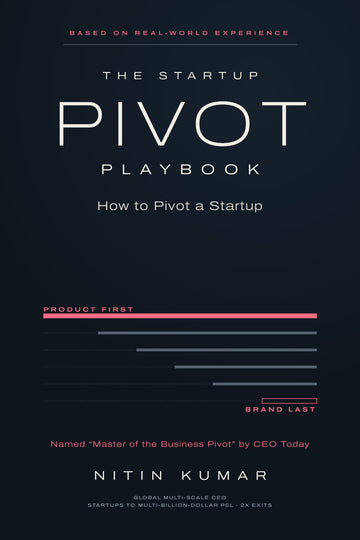
75 scored pivotsProduct-first moves succeeded in 21 of 33 cases; brand-first moves in 0 of 8.See the cases and method

2 pivots to exit as CEONitin Kumar’s operating experience sits alongside the case research.About the author

Free · In your browser · No email

The four-number traction test

Enter four numbers from last quarter. Each one is checked against the red line in Chapter 3 of The Startup Pivot Playbook, and each reading past the line names the chapter that deals with it. This is a one-quarter snapshot, not a decision to pivot. Use example numbers to see a filled-in result first.

%
%
months
x

The books

Pick the decision in front of you

At the IT operations software company I ran, a large bank renewed our monitoring and sent its expansion budget to a rival. Our churn stayed at zero. That renewal changed what I watched: the next budget told me more about our direction than the last renewal.

Nitin Kumar · Adapted from the Playbook preface

Startup pivots and diagnostics

AI pricing and economics

Fashion brands

All books, bundles and companions

Nitin Kumar, author of the Pivot Playbooks

The author

Nitin Kumar

Nitin Kumar has led a $2B+ P&L and taken two companies through pivots to exit as CEO. These books turn that experience into decisions and worksheets.

Read the operating record · Interviews and speaking

“Pricing AI Products is a must read for any founder.”Louise Laing, CEO and Founder, Alvalan, on Pricing AI Products

Questions

Ask your own through the contact page.

What is a startup pivot?

A startup pivot is a planned change in the problem a company solves for its customers. In The Startup Pivot Playbook, Nitin Kumar adds two tests: the company changes its core parts together, and it keeps at least one asset customers still value. A company that drifts into a new market by accident has not pivoted.

How do you pivot a startup?

Use the quarterly scorecard to decide whether to hold, adjust or open a pivot review. If the review justifies a pivot, define the proof point, check runway and sequence the changes to product, buyer, channel, price and team. In Nitin Kumar’s scored sample, product-first moves succeeded in 21 of 33 cases and brand-first moves in 0 of 8; those are observed outcomes, not a guarantee for the next company.

When should a startup pivot?

Open a pivot review when three or four traction components meet the scorecard’s weak-reading conditions. Apply each metric’s timing rule before counting. The review then tests the evidence, motive and runway before the team commits to a pivot. A current-quarter flag alone is not that decision.